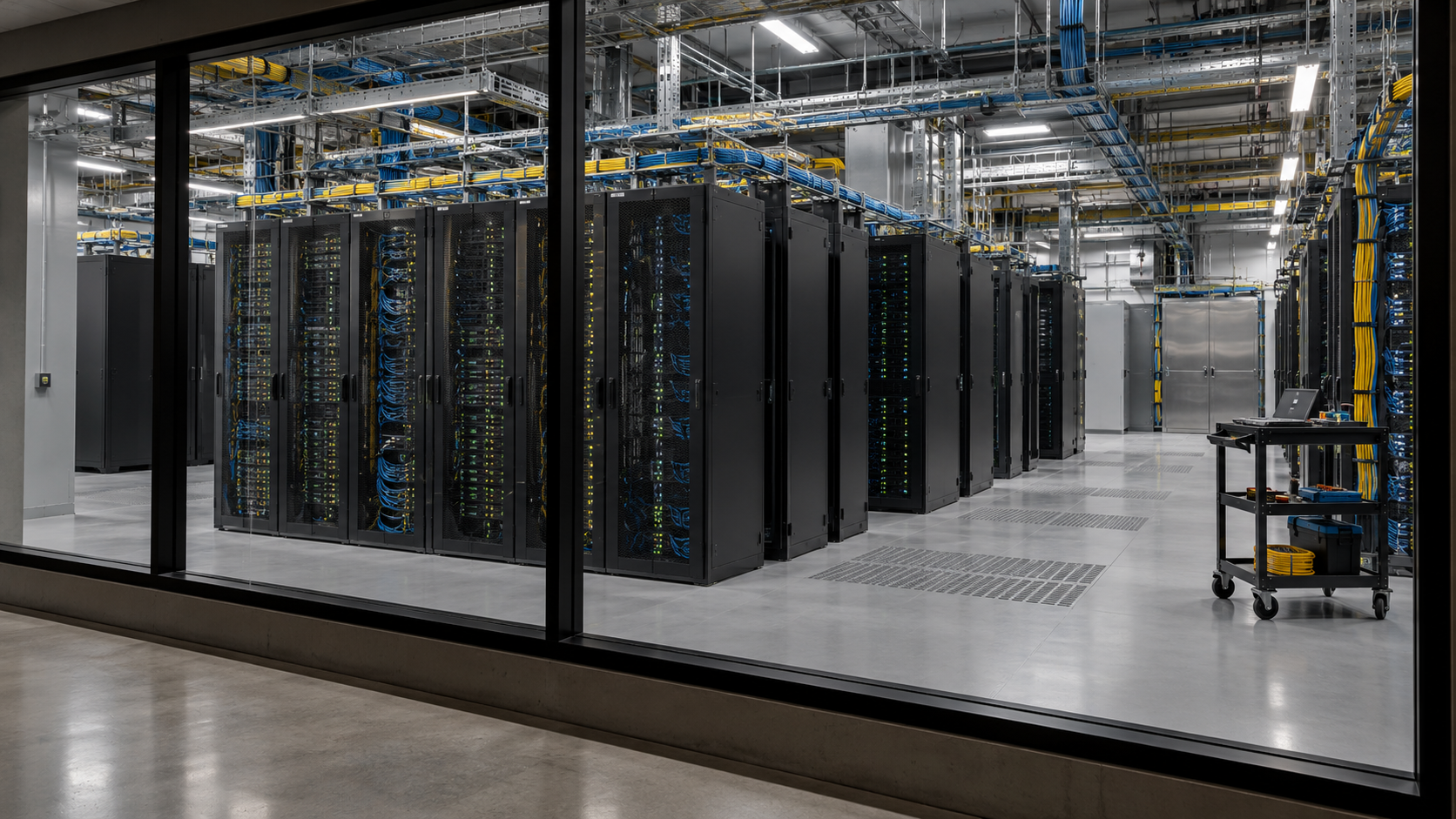
AI-generated conceptual image; not a photograph of an actual event.
Reporting cutoff: October 22, 2026, 11:30 KST (UTC+9). Event, release and data periods are identified below.
A friend’s AI-stock gains can make an ordinary savings account feel like a personal failure. That comparison offers no answer to the question that matters: how much future cash are you buying at today’s price?
Fresh results, competing signals
Meta’s October 21 after-market release reported third-quarter revenue of $64.601 billion, up 26% year over year. Operating cash flow was $32.786 billion; capital spending including finance-lease principal was $34.906 billion. Its defined non-GAAP free cash flow was negative $2.120 billion. The release arrived early October 22 in Korea.
Those figures describe expansion and a substantial funding requirement. They establish neither that AI demand is fictitious nor that the investment will earn an adequate return. Revenue growth across an advertising platform cannot automatically be assigned entirely to AI. Management’s attribution remains a claim to test against subsequent results.
Interpretation: comparison can turn research into a verdict hunt
Fear of missing out describes the pressure to catch up, not a clinical diagnosis. Raymond Nickerson’s 1998 review of confirmation bias examines selective treatment of evidence. An enthusiast may treat every spending increase as proof of opportunity; a skeptic may treat every cash outflow as proof of failure. Neither reading calculates a return on investment.
A practical counterweight is to write both a success case and a case in which rising sales fail to produce distributable cash. That is the author’s suggested discipline, not a finding about the motives of Meta shareholders.
Liquidity is not valuation
The same release reported September-end cash, equivalents and marketable securities of $82.45 billion and long-term debt of $80.922 billion. Subtracting those balances does not settle financial safety: lease obligations, commitments and maturities still matter. Equally, one negative free-cash-flow quarter does not by itself establish financial distress.
For a dated price reference, Meta Platforms, ticker META on Nasdaq, closed its October 20 regular session at USD694.25 at 4 p.m. EDT, or October 21 at 5 a.m. KST, in historical price data. This is a pre-results reference, not a measure of the reaction to the new release. A trailing P/E would require the full matching 12 months of EPS; annualizing one quarter or removing charges without justification would create misleading precision.
The useful valuation question is when infrastructure spending produces cash after operating costs and replacement investment. Faster utilization and better advertising economics could support the expenditure. Competition, power costs, depreciation and further investment could delay the payoff. Even a durable business can disappoint shareholders if the entry price assumes a faster payoff than it delivers.
The alternative to catching up
Waiting carries an opportunity cost if monetization accelerates. Buying carries a valuation risk if optimistic assumptions are already embedded. A household retirement plan needs a tolerable position size and an investment horizon, not a requirement to match somebody else’s best-performing holding.
Before you act
- Separate reported growth from management’s AI attribution.
- Reconcile operating cash flow, capital spending and lease principal.
- Read debt maturities and spending commitments, not cash alone.
- Match the price date with the correct EPS period and test slower monetization.
Sources and dates
- Meta, Q3 results, 2026-10-21 16:01 EDT / 10-22 05:01 KST
- Yahoo Finance, META history, 2026-10-20 regular close
- Raymond S. Nickerson, Review of General Psychology 2(2), 1998
Editorial note: Psychology passages are the author’s interpretation; market channels and counter-scenarios are conditional analysis, not established explanations of any individual trade.
AI-generated conceptual image; not a photograph of an actual event.
Related analysis: Earlier reporting and valuation context
한국어 기사: “AI 안 산 나만 바보?”…메타 실적에서 매출보다 먼저 볼 현금
글쓴이 소개





“Feeling Left Behind by AI Stocks? Meta’s Cash Bill Deserves Your Attention”의 2개의 생각